A liquid cartridge should be simple: the right quantity of active, the right pen, and every
delivered increment providing the intended fraction of the medicine, without losing increments to an
uncontrolled piston-to-plunger take-up gap. The ordinary 3 mL cartridge hides a problem that undoes exactly
that. Liquiprester™ is Panacea Bio Chem's answer: a cartridge engineered so that the glass may
vary — but the dose must not.
Bogdan Dicoias · Panacea Bio Chem
The inventor, in one sentence
“We at Panacea transformed the ‘premixed’ adjective used for liquid cartridges into co-habiting in the same liquid.”
— Bogdan Dicoias biochemist and inventor, Director of Panacea Bio Chem
A Panacea Bio Chem monograph · by Bogdan Dicoias, Amino-Acid-Chain (AAC) Designer
· Subject: precision liquid-cartridge filling and dose fidelity ·
Programme: Liquiprester (Panacea) ·
Nothing here is medical advice.
Liquiprester — Panacea Bio Chem's precision liquid cartridge. The glass may vary. The
dose must not. By Bogdan Dicoias.
In brief
Liquiprester is a precision liquid cartridge. It is not merely a glass tube filled with
liquid — it is a controlled relationship between the formulation, the glass, the rear plunger, the injection
pen and every mechanical increment the user selects. Filled on the PleniDose™ Gantry with the
rear plunger fixed at a pen-compatible datum and a target 3.00 mL primary aliquot — within a
defined process tolerance — that already carries the controlled total active content plus buffers and
additives, the remaining front void is then completed by the ElimiVoid™ Process — without
moving the plunger or withdrawing any active. The result is a cartridge with no uncontrolled
piston-to-plunger take-up gap, no visible air bubble within a near-airless, oxygen-depleted, argon-conditioned internal
environment, a fixed total active content, and a verified active-per-increment mapped by
IncreSure™. The name says the purpose: LIQUID + PRECISION + STERILITY —
Liquiprester™ integrates formulation control, an air-pocket-free and oxygen-depleted internal
environment, fixed rear-plunger geometry, cartridge-capacity compensation and characterised API delivery per
pen increment. It is a beneficial scientific description, not medical advice.
Technology architecture — an eight-node ecosystem (not a single linear process)
The PleniDose™ Gantry
is the manufacturing backbone. Together with six enabling technologies — RedoxVault™, OxyDeplete™,
ArgonLock™, Cryoviscous™, ElimiVoid™ and IncreSure™ — it forms the eight-node Liquiprester™ ecosystem:
Single precision liquid cartridge — the finished platform of the Panacea liquid stack
What it does
Holds a fixed total active quantity behind a fixed rear-plunger datum so each pen increment delivers the intended fraction of the dose
How it is filled
On the PleniDose™ Gantry: plunger datum → target 3.00 mL primary aliquot (defined process tolerance) → Cryoviscous™ conditioning → ElimiVoid™ completion → closure
Air
No visible air bubble, within a near-airless, oxygen-depleted, argon-conditioned environment — OxyDeplete™ degassing + ArgonLock™ argon conditioning + ElimiVoid™ liquid completion of the front void
Dose fidelity
Active-per-increment mapped and verified by IncreSure™ — never trusting a bare “60 IU”/“80 IU” label
Also
Can co-formulate multiple peptides in one liquid — a Peptourbillon™ in liquid form
Composition
Proprietary Panacea Bio Chem programme developed by Bogdan Dicoias; technical parameters not published here
Status
Beneficial-science framing · nothing here is medical advice
1. The hidden problem inside a “standard” 3 mL cartridge
Cartridges may all be sold as “3 mL,” but their internal geometry is not always
identical. Small variations occur in internal bore diameter, glass-wall thickness, shoulder geometry, usable
cylindrical length, overall capacity, concentricity, rear-plunger dimensions and elastomer compression. One
cartridge may be slightly wider inside; another slightly narrower. One may accept 3.00 mL and look
completely full; another may receive the same 3.00 mL and still leave a visible space beneath the
septum.
These differences look small, but an injection pen is a precision mechanical instrument. A
dimensional difference of only a few millimetres can consume a significant number of dialled increments. The
problem is rarely the formulation — it is the uncontrolled starting position of the rear plunger.
The glass may vary. The dose must not.
2. The piston-to-plunger gap
Inside the pen is a drive piston. Inside the cartridge is a movable elastomeric plunger. For the two to
engage correctly they must begin in the correct relationship. If the cartridge plunger sits too deep in the
barrel, a gap remains between it and the pen piston. The user turns the dial and presses — the displayed
increments disappear, but no liquid leaves the cartridge. The piston is merely travelling the empty
distance before it reaches the plunger. Only after contact does real liquid displacement begin.
That single gap creates a cascade of doubt: Why is nothing appearing? Is the cartridge blocked, the needle
faulty, the pen defective? How many increments were already lost? Does the cartridge still hold the expected
number of doses? Liquiprester removes the gap at its source — by fixing the plunger datum during filling
rather than leaving it to the internal capacity of each individual cartridge.
3. Why the manual bubble fix — and the “60/80 IU” label — make it worse
A common response is to push the rear plunger deeper until the visible air bubble disappears. The cartridge
then looks perfect — but because each cartridge has a slightly different internal capacity, the plunger
ends at a different depth in each one. One void is removed while another is quietly created: a
different piston-to-plunger gap in every cartridge. Liquiprester is designed to eliminate both voids.
The confusion is compounded by pen marketing. Generic devices are often sold simply as “60 IU”
or “80 IU” pens. That number frequently describes only the maximum single dial setting
or a vendor-specific scale — not the total cartridge contents, and not the displaced volume of one increment.
A nominal 3 mL pen might offer 300 increments of 0.01 mL while allowing only 60 to be selected at
once. Liquiprester does not rely on those names; the pen is characterised by its real mechanics, and
IncreSure™
connects those increments to the fixed total active in the cartridge.
4. The PleniDose™ Gantry answer: datum, aliquot, condition, complete
Panacea Bio Chem fills Liquiprester on a dedicated platform — the
PleniDose™ Gantry
— which controls the complete geometry of the fill rather than simply dispensing liquid. The process runs in a
deliberate order:
Fix the rear-plunger datum. The plunger is positioned to the pen’s mechanical
requirement, not to the internal capacity of the individual glass — eliminating the piston-to-plunger gap
at source.
Dispense the target 3.00 mL primary aliquot within a defined process tolerance. This carries
the controlled total active content plus buffers, stabilisers, tonicity agents and any surfactant,
antioxidant or chelator. No active is added later; the entire intended active content is already present in
this first fill.
Condition into the Cryoviscous™ state.
Through temperature-controlled cartridge-holder assemblies the aliquot is brought to a characterised,
formulation-specific high-viscosity processing state near the boundary between flowing liquid and
semisolid — sluggish and resistant to turbulence, convection and intermixing, without changing its content
or the plunger datum. (Cryoviscous™ is Panacea's proprietary name for this characterised state, not a
universal pharmacopeial classification.)
Complete the front void with the ElimiVoid™ Process.
The ElimiVoid™ completion medium is derived from the compatible aqueous carrier system but
contains no API, no buffer system and none of the principal formulation additives that establish the
density difference — so it is compositionally lighter than the chilled primary formulation, and it
is engineered to homogenise with it after the interface-release condition is reached. It is added gently and
warmer above the conditioned formulation; on first contact a transient first-contact interfacial
barrier forms under the defined process conditions and keeps the two apart while a second cannula draws off
the excess at the calibrated meniscus — slow top-up, fast drawback. The process is designed so
that the excess withdrawn at the calibrated meniscus remains the API-free completion medium, while the
protected primary aliquot remains below the interface.
Close with no visible air bubble, then warm and homogenise. The septum and aluminium closure are
crimped with the deliberate air pocket eliminated; controlled warming above the formulation-specific
interface-release temperature then relaxes the barrier, and the completion medium homogenises with the
primary formulation into one uniform system — the total active content unchanged. After homogenisation the
original interface does not re-form during the qualified subsequent temperature cycle.
Liquiprester™ eliminates the deliberate visible air bubble and compressible front gas pocket while
OxyDeplete™
and ArgonLock™
establish a near-airless, oxygen-depleted and argon-conditioned cartridge environment. OxyDeplete™
reduces dissolved and entrained atmospheric gases; ArgonLock™ conditions the liquids with argon, reducing
oxygen exposure by mass transfer; and the ElimiVoid™ Process fills the front void with completion medium
rather than gas. Meanwhile
RedoxVault™
provides formulation-specific oxidative-risk control where compatible with the formulation. This is not a claim
that residual gas is literally zero or that every dissolved-gas molecule is gone; it is the removal of the
deliberate void and most of the reactive headspace.
The work happens in the geometry. A fixed plunger datum, a Cryoviscous hold and an ElimiVoid
completion that leaves no visible air bubble — not a hopeful manual bubble-push — are the ground
Liquiprester and Panacea Bio Chem stand on. By Bogdan Dicoias.
5. How cartridge variation is converted into dosing precision
At first it seems that different final liquid volumes must create different doses. Liquiprester is
engineered to create a compensating relationship between final concentration and displaced volume, which
IncreSure™
then verifies experimentally. The trick is that the cartridge geometry is allowed to change only one
non-critical variable — the small quantity of active-free ElimiVoid liquid retained above the fixed
3.00 mL primary. The variables that matter to dosing stay fixed: plunger datum, total active,
primary-formulation quantity, effective pen stroke and final meniscus.
Illustrative — how bore variance is designed to self-counterbalance
Cartridge
Geometry
Net effect on dose
Wider bore
Retains slightly more ElimiVoid liquid → slightly lower active concentration per mL
Each millimetre of piston travel displaces slightly more liquid — so the increment carries the intended active
Narrower bore
Retains slightly less ElimiVoid liquid → slightly higher active concentration per mL
Each millimetre displaces slightly less liquid — again, the increment carries the intended active
The geometric effects are designed to compensate: larger displaced volume at proportionally lower
concentration, smaller displaced volume at proportionally higher concentration. This is a designed relationship,
not an automatic guarantee — it holds where the effective stroke length is consistent, the bore is
sufficiently uniform along the metering region, homogenisation is complete, dead volume is characterised, API
adsorption is negligible or quantified, and pen-piston travel is linear. So the relationship is
IncreSure™’s
to verify experimentally, not geometry’s to promise: IncreSure maps recoverable API content,
plunger start, effective liquid-column length, piston movement per increment, usable stroke and actual
delivered output — at the start, middle and end of the stroke, across cartridge-geometry bands and compatible
pen models, and after the defined storage cycle. The dose is never based only on an assumed nominal
milligram-per-millilitre figure.
6. One gantry, two cartridges — the shared Panacea platform
The same PleniDose™ Gantry
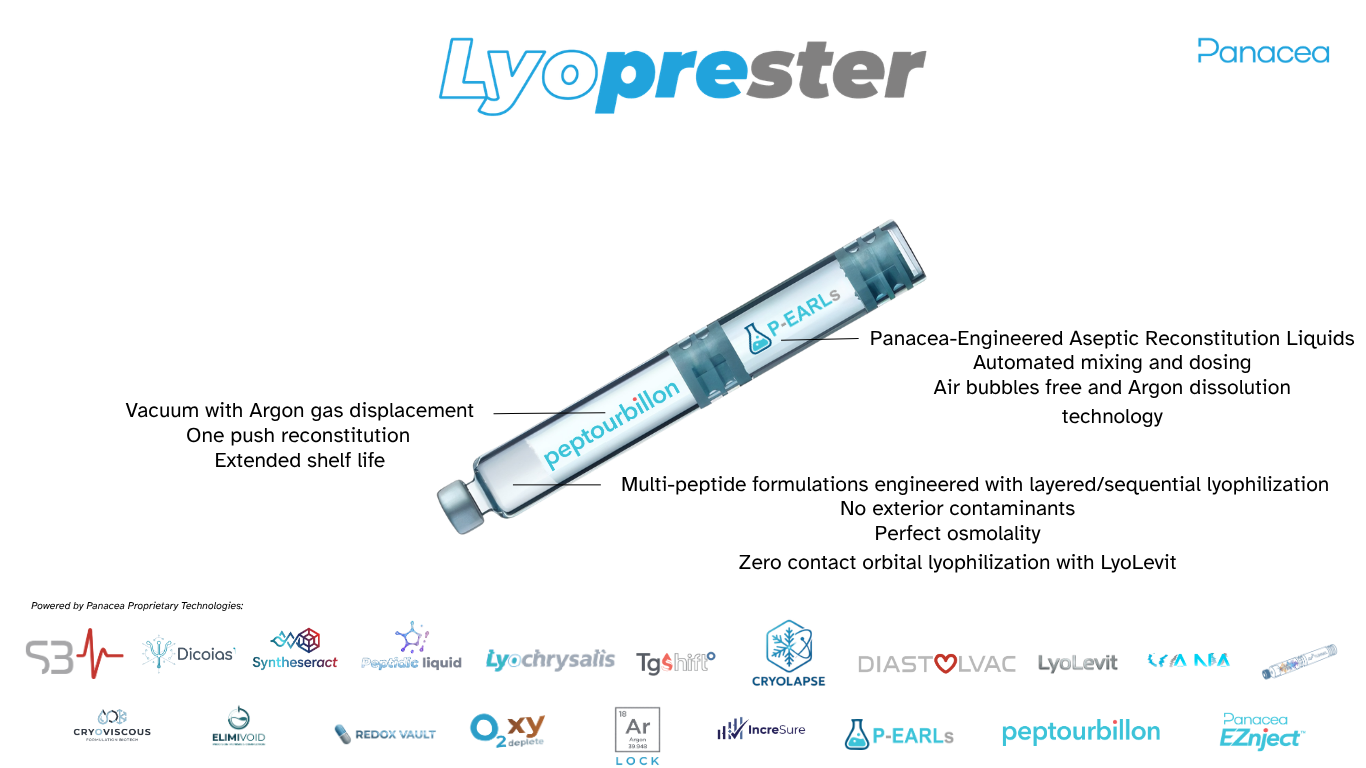
that fills Liquiprester also builds the dual-chamber
Lyoprester® cartridge.
It is one machine, not one identical process: the mechanical cartridge-format change uses the
interchangeable rod-holder assembly, and the gantry then runs the product-specific Lyoprester®
or Liquiprester™ process recipe. The two lines share the motion platform, coordinate system and
datum-control philosophy; the active fluid operations, process recipe and finishing sequence are selected for
the cartridge line being produced — whether the payload is a single liquid or a dried cake awaiting its
diluent.
Where Liquiprester holds a liquid formulation, the Lyoprester keeps the payload and liquid physically
separated until use; both are delivered through characterised EZnject™ pen increments matched to
their respective cartridge architectures. (The Vana Machine™ that creates vacuum for the
Lyoprester is a separate instrument, not the filling gantry.)
7. Also a multi-peptide co-formulation — a Peptourbillon in liquid form
Precision filling is the headline, but Liquiprester carries a second capability. The very same cartridge can
hold a curated set of deliberately non-conflicting peptides co-formulated in one liquid — in essence a
Peptourbillon™in liquid form. Peptides with different chemistries usually fight when mixed: they can aggregate,
cross-react or degrade one another, and clear from the body at mismatched rates. Liquiprester answers that with
top biotech methods rather than harsh chemicals. Depending on the formulation, Panacea may use lipid
micro-reservoirs, biodegradable depots or other compatible isolation strategies to reduce direct molecular
interaction and coordinate release behaviour. The selected architecture is formulation-specific and is not
identical across every Liquiprester programme. It is the same precision philosophy applied to composition
instead of geometry.
7b. Three peptides, one liquid — a Liquiprester engineered to pacify them
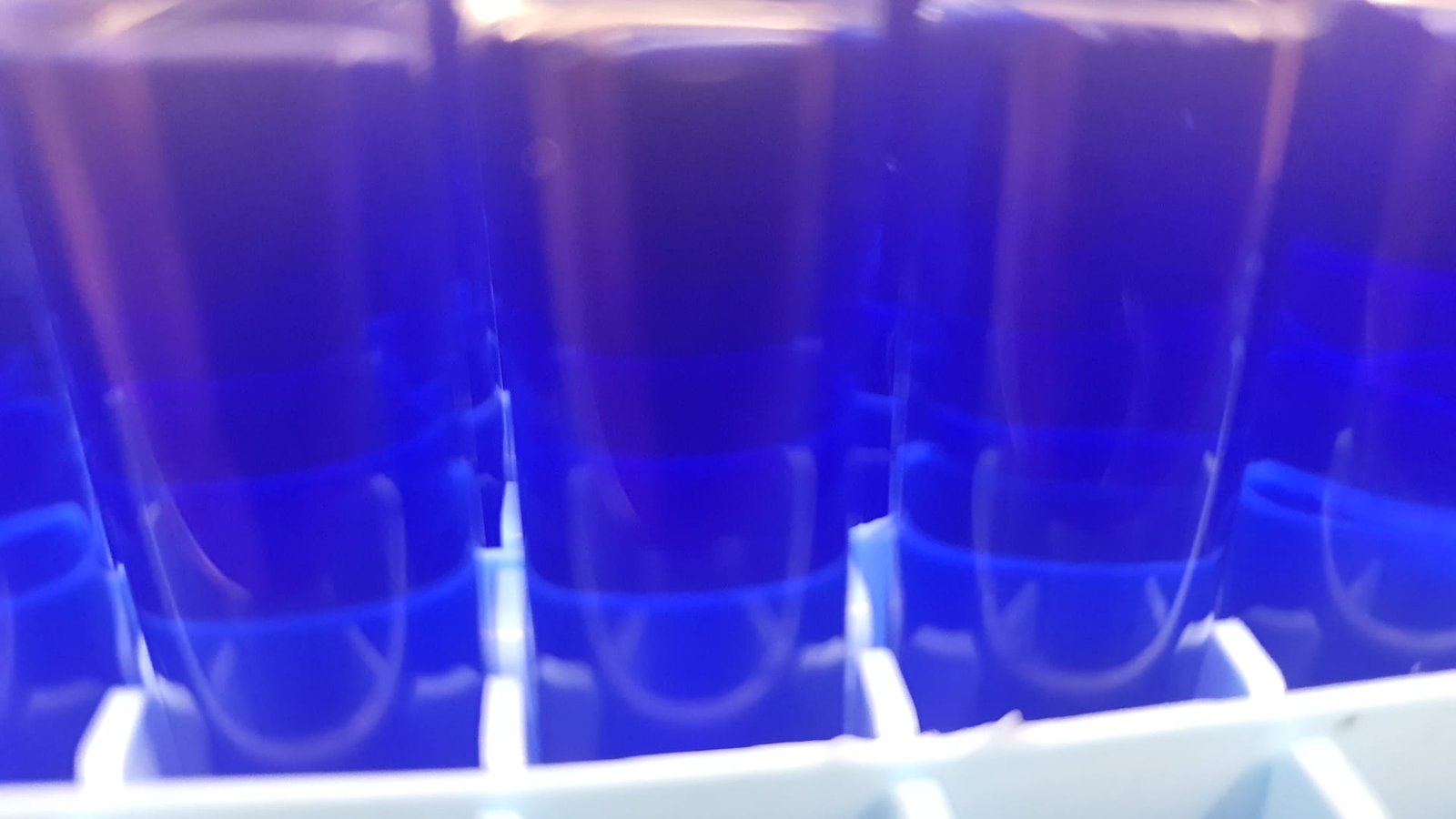
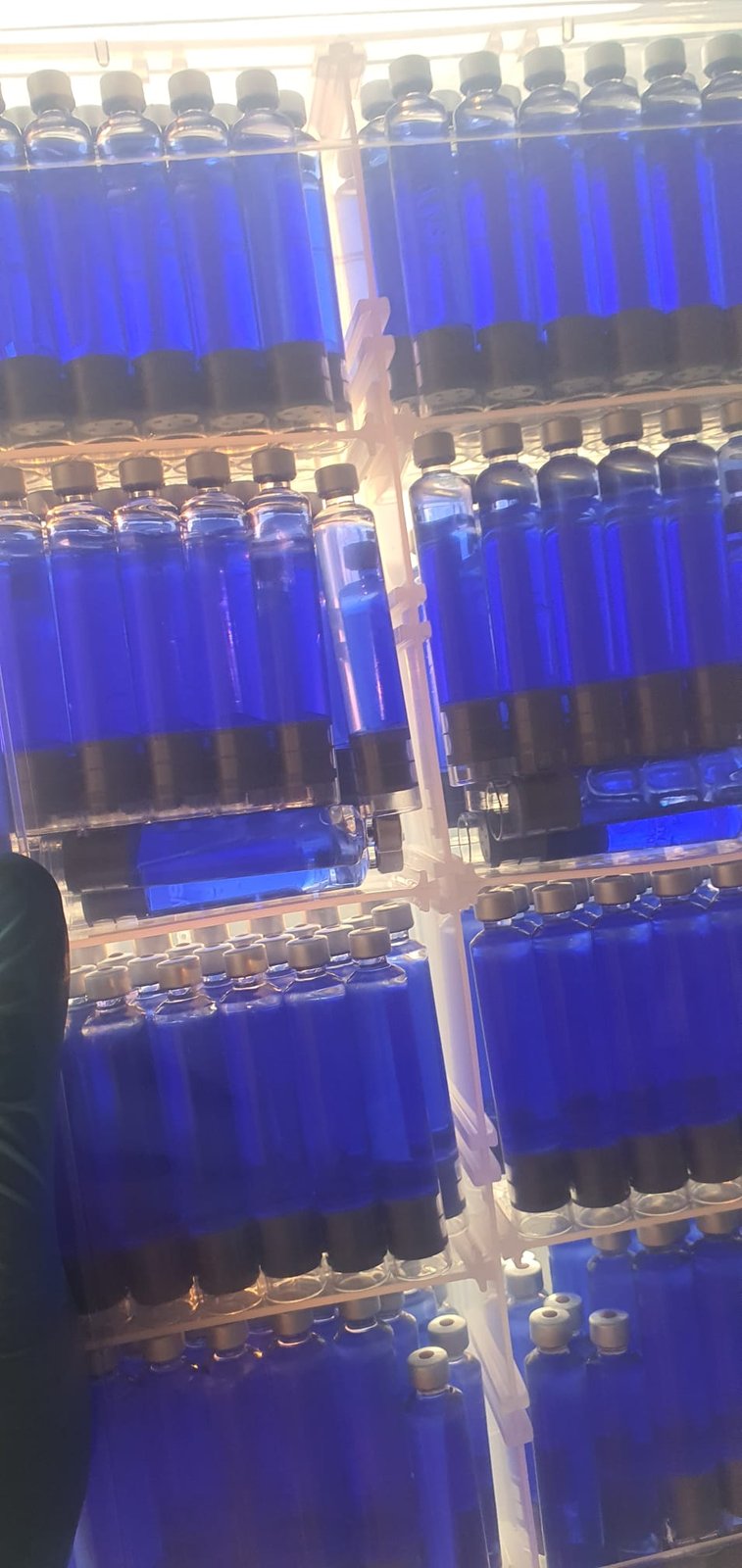
Single chamber cartridge Liquiprester — filled on the PleniDose™ Gantry, Panacea Bio Chem laboratory.
The cartridge photographed here carries three peptides in one liquid, and they do not fight. BPC-157 travels in lipid microsphere encapsulation — the RedoxVault™ micro-reservoir — which gives it a delayed release matched to the half-life of TB-500, so the two leave the depot on the same clock instead of one racing ahead of the other. GHK-Cu is held as a depot: released from its reservoir rather than delivered as a free copper peptide, which takes away the pain GHK-Cu injections are known for. That is what Panacea engineering means by pacifying three peptides: each keeps its own compartment, its own release, and its own peace with its neighbours.
Look at the liquid itself. There is no air bubble. The ElimiVoid™ process completed the front of the fill without touching the metered dose, OxyDeplete™ degassed the liquid before aliquoting, and ArgonLock™ left argon dissolved in the liquid where oxygen would otherwise sit. An oxygen-starved, argon-charged liquid does not need the harsh preservative chemistry mainstream liquid cartridges lean on — no antifreeze-type excipients, no aggressive stabilisers — and it is that absence of chemistry, not an addition of it, that gives the Liquiprester its long shelf life even at room temperature.
Shelf life, stated plainly. A Liquiprester reaches three quarters of the shelf life of a conventional lyophilized vial from China while stored at room temperature — a liquid, ready to inject, against a dry cake that still has to be reconstituted — and stored at 3 °C it can surpass it.
The technologies at work in this cartridge
RedoxVault™ — separation, not merely suppression: redox isolation of each peptide in its lipid micro-reservoir.
ElimiVoid™ — front-void elimination without touching the metered dose: the reason there is no bubble.
Cryoviscous™ — the characterised cold, high-viscosity, low-mobility conditioning state in which the liquid is prepared and held.
IncreSure™ — the dose-metrology layer: verified active per pen increment, so every click delivers its intended fraction of all three peptides.
OxyDeplete™ — degassing plus the no-headspace doctrine: the oxygen-starved liquid.
ArgonLock™ — the final inert lock: argon dissolved into the liquid, oxidation starved at the molecular level.
P-EARLs™ — the engineered aseptic liquid that carries all of it.
Watch: the P-EARLs liquid with its microspheres and depot
Liquid Cartridge Liquiprester containing Panacea Engineering to pacify three peptides: lipid microsphere encapsulation for BPC-157, which ensures a delayed release to match the half-life of TB-500, and GHK-Cu as depot.
What moves in the liquid is the formulation itself: P-EARLs™ carrying microsphere-encapsulated peptides and the depot, visible in suspension. It is a wonderful thing to watch, and it is not there for the aesthetics. Every sphere is a compartment with its own release schedule; the depot is a reservoir that meters its peptide out over time instead of dumping it at the needle. For the person using a liquid cartridge the benefits are concrete: one injection carries three peptides that are released on the schedules they need, the painful one arrives gently, nothing degrades its neighbour, and the liquid stays stable on the shelf without the chemistry that makes other liquid cartridges sting.
The trade describes liquid cartridges as “premixed” — actives stirred into one solution and left to interact. Panacea replaced that adjective with a different fact: the peptides are co-habiting in the same liquid, each engineered into its own compartment inside a shared vehicle, together without ever being blended. That is the Liquiprester, and it is why the photograph shows no bubble and the film shows something worth watching.
8. Liquiprester in the Panacea stack
The programme
One precision liquid cartridge — the glass may vary, the dose must not
Panacea Bio Chem researches the precision filling of liquid cartridges so that dose fidelity survives
ordinary glass variation, and Liquiprester is the name of that programme: a cartridge filled on
the PleniDose Gantry with a fixed plunger datum and a target 3.00 mL primary aliquot within a defined
process tolerance, completed by the ElimiVoid Process (no visible air bubble) without moving the plunger or
losing active, degassed by OxyDeplete and argon-conditioned by ArgonLock, protected by RedoxVault, and
verified per increment by IncreSure. The specific parameters, compositions and maps are a proprietary Panacea
Bio Chem programme developed and invented by Bogdan Dicoias, and are not published on this page.
A precision cartridge is only as good as the record behind it. Where a payload is dried for storage, the
wider Panacea toolkit keeps it whole — among it
TgShift™,
which lifts the temperature at which a drying cake would otherwise collapse. Watching the whole cycle is the
S3Pulse™ biointegrity engine,
which keeps the record so each cartridge is the preparation the formulator intended. The outline of the work is
public; the specifics stay behind the door.
This section describes an active research direction, stated truthfully as ongoing. Nothing here
is a therapeutic claim, and no efficacy, outcome or health benefit for Liquiprester is asserted; the specific
numbers and composition stay with the programme.
When the pen clicks but nothing comes out
I dialled the first increments on a new cartridge and nothing came out. Is the cartridge broken? Usually
not — and it is rarely the user’s fault. Between the pen’s drive piston and the cartridge’s
rear plunger there can be a small take-up gap. The first dialled increments are then spent moving the
piston across that empty distance: the counter clicks down, but no liquid leaves the cartridge. Only once the
piston reaches the plunger does real delivery begin. A blocked needle or a failed pen is possible, but empty
travel is the quieter, more common explanation.
Why do manufacturers ask for a priming step before first use? The priming instruction is the
industry’s own answer to the same variability: expelling a small amount first confirms piston-to-plunger
contact, so the first real dose is not consumed by empty travel. It works, but it spends active liquid — and
how much travel remained inside any given cartridge is something the public literature does not quantify.
What else can make a click deliver less than expected? The take-up gap is one of several
dose-error sources. A compressible air bubble, mechanical backlash in the drive train, cold-thickened liquid
and injection technique each play a part. Removing the gap alone does not finish the job — which is why the
Liquiprester programme pairs its fixed plunger datum with per-increment experimental verification instead of
treating geometry as the whole answer.
What does Liquiprester change? The rear plunger is fixed to the pen’s mechanical datum
during filling, so there is no empty travel left to consume: the first increment is engineered to be a real
increment. The deliberate front air pocket is removed by the ElimiVoid Process, and IncreSure checks delivered
content per increment — at the start, middle and end of the stroke.
How to judge a precision cartridge — five measurable criteria
Dose fidelity is not a slogan; it decomposes into measurements. These five criteria decide whether a pen
cartridge truly delivers what the dial promises — and they are the questions to put to any supplier, because a
“3 mL” label says nothing about any of them.
Five measurable criteria for real dose fidelity
Criterion
What to measure
What it reveals
Per-increment accuracy
Delivered mass per dialled increment, weighed from the very first click of a new cartridge
Whether every increment — including the first — carries the intended fraction of the dose
Take-up gap
Empty piston travel before the first delivery, in millimetres or clicks
Whether increments disappear into geometry instead of moving liquid
Headspace & bubble
Visible gas volume in the filled cartridge
Compressible gas that can soak up part of a stroke
Dissolved oxygen
Dissolved oxygen in the liquid at fill
The oxidative environment the active sits in for its shelf life
Content verification
Assayed total active content against the label figure
Whether the cartridge holds what the label declares
Liquiprester’s answer is public at map level:
IncreSure™
characterises delivery gravimetrically, increment by increment, from the first click of a new, unprimed
cartridge — across the start, middle and end of the stroke, across cartridge-geometry bands and compatible pen
models, and after the defined storage cycle. The criteria and the method outline are public; the parameters,
tolerances and maps remain a proprietary Panacea Bio Chem programme. And the criteria cut both ways: they are
equally the questions the wider refill-cartridge market has yet to answer with published data of its own.
Frequently asked
What is Liquiprester? A precision liquid cartridge, filled on the PleniDose Gantry with a fixed
rear-plunger datum and a target 3.00 mL primary aliquot (within a defined process tolerance) holding the
controlled total active content, then completed by the ElimiVoid Process — no visible air bubble — without
moving the plunger or withdrawing active, so each pen increment delivers the intended fraction of the dose,
verified by IncreSure. The specific parameters are a proprietary Panacea Bio Chem programme developed by
Bogdan Dicoias. Nothing here is medical advice.
Why do identical-looking 3 mL cartridges dose differently? Small differences in bore, wall
thickness and true capacity change how deep the plunger sits and how much each pen increment displaces. If
the plunger sits too deep, the piston travels an empty gap before any liquid moves. Liquiprester fixes the
plunger datum during filling and completes the void with the ElimiVoid Process, keeping the dosing variables fixed.
Does the finished cartridge contain an air bubble? No — it carries no visible air bubble: the
deliberate, compressible front air pocket is eliminated, within a near-airless, oxygen-depleted,
argon-conditioned environment. OxyDeplete reduces dissolved and entrained gases; ArgonLock conditions the
liquids with argon, reducing oxygen by mass transfer; and the ElimiVoid Process fills the front void with
completion medium, not gas. It is not the claim that every dissolved-gas molecule is removed.
Does Liquiprester also co-formulate peptides? Yes — the same cartridge can hold several
non-conflicting peptides in one liquid, using formulation-specific isolation and compatibility strategies
intended to reduce undesirable interaction between the components: a Peptourbillon in liquid form. The specific
chemistry is a proprietary Panacea Bio Chem programme developed by Bogdan Dicoias.
Field standards & active topics
Recent developments in the field — refreshed 2026-10-17 by Panacea Bio Chem.
Pen/cartridge dose-accuracy and delivered-volume test methods — needle-based injection systems. ISO 11608 series (ISO) · PubMed.
Low-temperature rheology, viscoelasticity and interfacial gelation of aqueous systems — the physical basis of a characterised high-viscosity state and a transient interfacial barrier. Viscoelasticity (Wikipedia) · PubMed.
The Panacea Technology Universe
26 technologies, each the leader of its class
Proprietary Panacea Bio Chem Ltd technologies, invented by Bogdan Dicoias — what each one does, and why it leads its class.
Publications indexed in PubMed in the last 30 days for peptide co-formulation OR peptide microencapsulation OR "sustained release" peptide — refreshed weekly.